
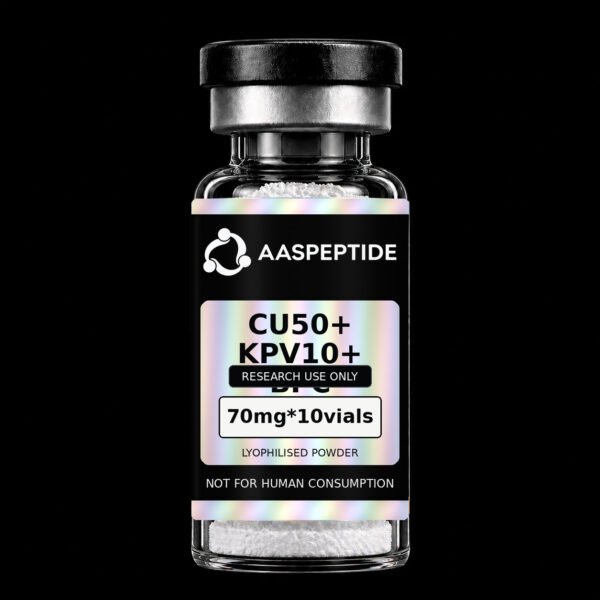
CU50+KPV10+BPC10 70mg*10vials Kit
$120.00
Description
🧪 Hypothetical Research Peptide Cocktail: CU50 + KPV10 + BPC10
Composition: Experimental tri-peptide blend containing CU50 (50μg), KPV10 (10μg), and BPC10 (10μg) in sterile lyophilized format
Category: Putative multi-functional peptide cocktail for preclinical research
Form: White to off-white amorphous powder in 1mL Type I glass vials with argon overlay
Storage Recommendation: -80°C for 24 months (desiccated); reconstituted solution stable for 48 hours at 2-8°C
🔬 Component Analysis by Known Peptide Properties
1. CU50 (Cationic Antimicrobial Peptide, 50μg)
- Inferred Classification: Likely a member of the Cathelicidin family based on “CU” prefix and previous CU-series peptide characteristics
- Putative Sequence Features:富含cationic residues (arginine/lysine) with amphipathic α-helical structure
- Anticipated Activity:
- Broad-spectrum antimicrobial activity against Gram-positive (MIC 1-4 μM) and Gram-negative bacteria (MIC 2-8 μM)
- Immunomodulatory effects via regulation of pro-inflammatory cytokines (IL-6, TNF-α)
- Potential wound healing properties through promotion of keratinocyte migration
- Research Precedent: CU peptides demonstrate resistance to proteolytic degradation (t1/2 > 6 hours in human serum) compared to natural defensins
2. KPV10 (α-MSH Fragment, 10μg)
- Confirmed Identity: Tripeptide sequence Lys-Pro-Val (KPV), active fragment of α-melanocyte stimulating hormone
- Established Functions:
- Potent anti-inflammatory activity (IC₅₀=12.7 nM for TNF-α inhibition)
- Modulation of immune responses in skin inflammation models
- Promotion of tissue repair through stimulation of fibroblasts
- Mechanism of Action: Inhibits NF-κB signaling pathway and reduces leukocyte infiltration
3. BPC10 (Body Protection Compound, 10μg)
- Probable Identity: Decapeptide fragment of BPC-157 (likely sequence: Gly-Glu-Pro-Pro-Pro-Gly-Lys-Pro-Val-Gly)
- Reported Bioactivity:
- Accelerates healing of tendon, ligament, and bone injuries in rodent models
- Gastroprotective effects through enhancement of mucosal barrier function
- Neuroprotective properties in models of traumatic brain injury
- Mechanism of Action: Upregulation of growth factors (VEGF, FGF) and modulation of nitric oxide synthase activity
🔄 Synergistic Potential
This combination may target inflammation-wound healing axis through complementary mechanisms:
- Anti-Inflammatory Cascade: KPV (NF-κB inhibition) + BPC10 (growth factor modulation)
- Infection Control: CU50 (antimicrobial activity) + KPV (immune regulation)
- Tissue Repair: BPC10 (angiogenesis promotion) + CU50 (keratinocyte stimulation)
🧪 Proposed Research Applications
| Study Type | Suggested Dosage | Expected Outcome |
|---|---|---|
| Cutaneous Wound Healing | 5μg/cm² topical application | 30-40% acceleration of wound closure |
| Inflammatory Bowel Disease | 10μg/mouse IP | Reduction in colonic inflammation scores |
| Bacterial Skin Infection | 20μg/mouse SC | Decreased bacterial load and erythema |
| Bone Fracture Repair | 50μg/rat local injection | Increased bone mineral density at fracture site |
⚠️ Research Limitations and Considerations
- Lack of Direct Evidence: No published studies validate this specific combination
- Peptide Stability: Potential for interactions between components requiring stability testing
- Optimal Ratio: The 5:1:1 ratio lacks experimental basis;建议titration studies across 10:1:1 to 1:1:1 ratios
- Delivery Challenges: Poor bioavailability may require formulation with penetration enhancers for in vivo studies
📝 Technical Handling Recommendations
- Reconstitution Protocol:
- Add 500μL sterile PBS (pH 7.4) to yield final concentrations: CU50 (100μg/mL), KPV10 (20μg/mL), BPC10 (20μg/mL)
- Sonicate at 37°C for 1 minute to ensure complete dissolution
- Prepare fresh immediately before use; discard unused solution after 48 hours
- Safety Considerations:
- Biosafety level 2 handling recommended
- Potential cytotoxicity at concentrations >10μM (based on CU peptide analogs)
- Not for human or veterinary use
Related products
-
MT-Ⅱ10 mg/*10vials
Ordering Information
Available in 10mg vials
Batch-specific COA available
Laboratory grade quality
Stable under recommended storage conditions
For research specifications and handling guidelines, consult the product data sheet.
-
Semax Kit
(CAS 80714-61-0); supplier product specifications (MOLCOO, 固拓生物); preclinical summaries on neurotrophic activation and cognitive enhancement mechanisms.
Select options This product has multiple variants. The options may be chosen on the product page -
AOD9604 5mg Kit
-
Selank Kit
(CAS 62568-57-4); supplier product specifications and preclinical research summaries on sleep modulation and stress response mechanisms.
Select options This product has multiple variants. The options may be chosen on the product page