
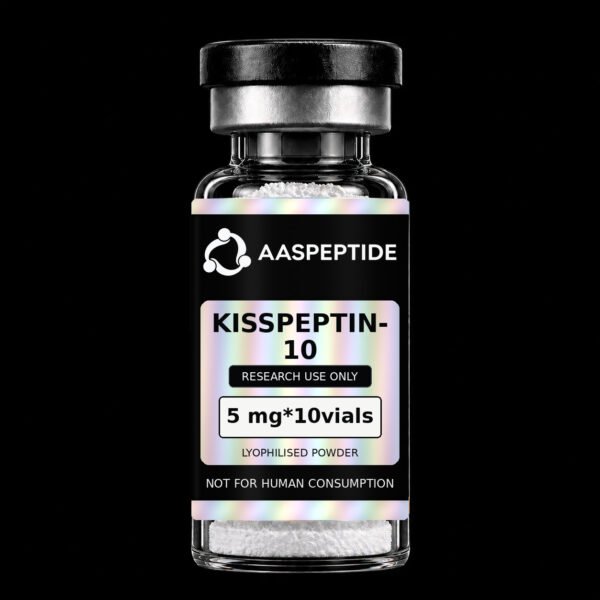
KissPeptin-10 Kit
Price range: $66.00 through $107.00
Description
🧪 Product Profile: KissPeptin-10
Product Name: KissPeptin-10 (KP-10)
CAS Number: 692268-55-0
Category: Hypothalamic neuropeptide; GPR54 agonist
Form: Lyophilized white powder in amber glass vials
Molecular Formula: C₅₉H₈₉N₁₇O₁₄
Molecular Weight: 1302.46 g/mol
Purity: ≥98% (HPLC verified, TFA-free formulation)
🔬 Key Properties
- Amino Acid Sequence: YNWNSFGLRF-NH₂ (C-terminal decapeptide fragment of full-length kisspeptin-54)
- Solubility:
- Water: ≥10 mg/mL (clear solution at pH 6.5-7.5)
- PBS buffer: 13.8 mg/mL (10.6 mM at 25°C)
- DMSO: Limited solubility (<2 mg/mL)
- Stability Profile:
- Lyophilized: 24 months at -20°C; 12 months at 4°C (desiccated)
- Reconstituted: 72 hours at 4°C; avoid repeated freeze-thaw cycles
- Biophysical Characteristics:
- Isoelectric point (pI): 9.87
- Secondary structure: Random coil in aqueous solution; α-helical propensity in membrane-mimetic environments
🧠 Mechanism of Action
KP-10 functions as the endogenous ligand for GPR54 (KISS1R), a Gq-coupled receptor, triggering:
- Intracellular Signaling: Phospholipase C activation → IP3/DAG pathway → Ca²⁺ mobilization (EC₅₀=0.3 nM)
- Reproductive Axis Activation: Stimulates GnRH neuron firing in the hypothalamic arcuate nucleus, leading to LH/FSH secretion
- Dose-Dependent Responses:
- Low dose (1 nM): Pulsatile GnRH release (physiological pattern)
- High dose (100 nM): Sustained gonadotropin secretion (pharmacological effect)
- Tissue Expression: Expressed in hypothalamus, pituitary, placenta, pancreas, and reproductive tissues
🧪 Research Applications
Widely used in reproductive neuroendocrinology and related fields:
- Puberty Studies: Induces precocious puberty in prepubertal rodents (5 nmol, ICV injection)
- Fertility Research: Restores gonadotropin secretion in hypogonadotropic hypogonadism models
- Cancer Biology: Investigates GPR54-mediated signaling in metastatic melanoma and breast cancer
- Metabolic Regulation: Modulates glucose homeostasis via pancreatic islet cell activation
- Neuroscience: Role in mediating stress-induced reproductive dysfunction (50 μg/kg, i.p. in chronic stress models)
⚙️ Handling & Administration
- Reconstitution Protocol:
- Add sterile water to achieve 1 mg/mL stock solution
- Dilute with assay buffer to working concentrations (typically 10-1000 nM)
- Adjust pH to 7.2 with 0.1M NaOH if precipitate forms
- Administration Routes:
- Intracerebroventricular (ICV): 1-10 nmol in 2 μL artificial cerebrospinal fluid
- Intraperitoneal (IP): 10-100 μg/kg in saline
- In vitro: 10 nM-1 μM for cell culture studies
- Typical Dosing Regimens:
- Acute studies: Single bolus injection
- Chronic studies: Daily injections for 7-14 days (rodent models)
📦 Packaging & Quality Control
- Standard Packaging: 1 mg, 5 mg, and 10 mg vials with butyl rubber stoppers
- Quality Assurance:
- Endotoxin level: ≤0.1 EU/mg
- Amino acid analysis: Within ±5% of theoretical composition
- Mass spectrometry: Confirmation of [M+H]⁺ = 1303.7 m/z
- Storage Configuration: Individually packaged with silica gel desiccant
🧪 Biological Assays & Validation Data
| Assay Type | Protocol | Typical Result |
|---|---|---|
| GPR54 Binding Assay | Competitive displacement of [¹²⁵I]-KP-10 | Ki = 0.42 nM (human GPR54 transfected cells) |
| Calcium Mobilization | FLIPR assay in CHO-K1/GPR54 cells | EC₅₀ = 0.31 nM; Emax = 127% of control |
| LH Secretion (Rat Pituitary) | Static incubation, RIA measurement | 3.2-fold increase at 100 nM KP-10 |
| GnRH Neuron Activation | Patch clamp recording in hypothalamic slices | 85% increase in firing rate (500 nM) |
⚠️ Safety & Regulatory Considerations
- Hazard Classification: Not classified as hazardous (GHS 0) for research use
- Handling Precautions:
- Use nitrile gloves and protective eyewear during reconstitution
- Avoid inhalation of lyophilized powder (use biological safety cabinet)
- Regulatory Status: Research Use Only (RUO); not for human or veterinary therapeutic use
- Special Notes:
- May interfere with reproductive studies in female rodents during estrous cycle
- Requires serum-free media for in vitro studies (serum peptidases degrade KP-10)
Additional information
| FORMAT | 10Bottlex5mg, 10Bottlex10mg |
|---|
Related products
-
BPC-157/TB-500 BLEND 20mg Kit(BB20)
BPC-157 / TB-500 Blend – 15 mg
Regenerative Peptide Combo | Musculoskeletal Repair + Whole Body Recovery
(5 mg BPC-157 + 10 mg TB-500 per bottle)
Overview:
This powerful peptide blend combines BPC-157 and TB-500, two of the most researched peptides for tissue regeneration, anti-inflammatory and injury repair. When used together, BPC and TB-500 create a synergistic effect that supports local healing and systemic repair mechanisms throughout the body.
Ideal for athletes, active individuals or those recovering from soft tissue injuries, this blend is often used in treatment regimens for tendinitis, ligament injuries, muscle strains and post-surgery recovery.
-
BPC 5mg+TB 5mg(BB10)
-
CJC-1295 without dac 5mg+IPA 5mg Kit
(CJC-1295: 863288-34-0; Ipamorelin: 170851-70-4); supplier product specifications (Wuhan Boyuan Import & Export, Hebei Ganmiao New Material Tech); preclinical summaries on GHRH/GHS-R1a synergism.
-
Epitalon Kit
(CAS 307297-39-8); supplier product specifications (Zhuzhou New Peptides Tech Co., Ltd., Dideu Industries); preclinical summaries on telomerase activation and anti-aging mechanisms.
Select options This product has multiple variants. The options may be chosen on the product page