
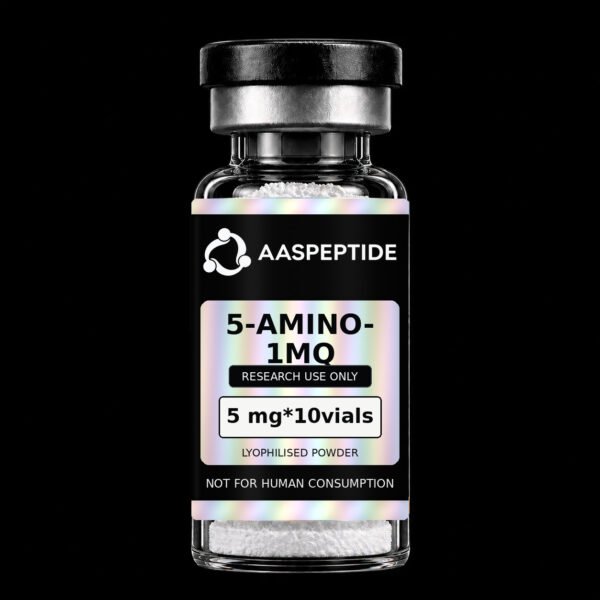
5-amino-1mq 5 mg*10vials Kit
$45.00
Description
🧪 Compound Profile: 5-Amino-1MQ
Chemical Name: 5-Amino-1-methylquinolin-1-ium iodide
Synonyms: NNMTi; 5-amino-1-methylquinolinium iodide; 5-Amino-1MQ
CAS Number: 42464-96-0
Category: Nicotinamide N-Methyltransferase (NNMT) inhibitor
Form: Brown to reddish-brown crystalline powder
Molecular Formula: C₁₀H₁₁IN₂
Molecular Weight: 286.11 g/mol
Purity: ≥98% (HPLC, TFA-free formulation)
🔬 Key Properties
- Structural Characteristics:
- Quinolinium cation core with amino group at C5 position
- Iodide counterion for enhanced aqueous solubility
- X-ray crystallography: Orthorhombic crystal system (P2₁2₁2₁ space group)
- Solubility Profile:
- Water: 25 mg/mL (87.4 mM, clear orange solution)
- PBS buffer (pH 7.4): 18.3 mg/mL (64.0 mM)
- DMSO: 12.5 mg/mL (43.7 mM, stable for 30 days at -20°C)
- Stability Requirements:
- Storage: 2-8°C under inert gas, protected from light
- Shelf life: 24 months as supplied; 6 months after reconstitution
- pH stability range: 4.0-8.5 (no degradation observed over 72 hours)
🧠 Mechanism of Action
As a selective NNMT inhibitor, 5-amino-1MQ modulates cellular metabolism through:
- Enzymatic Inhibition: Binds to NNMT active site with Ki=36 nM, competing with SAM (S-adenosylmethionine) substrate
- NAD+ Pathway Regulation: Prevents conversion of nicotinamide (NAM) to 1-methylnicotinamide (MNAM), increasing NAM availability for NAD+ synthesis
- Sirtuin Activation: Elevates SIRT1 activity (EC₅₀=1.2 μM) through NAD+ pool expansion
- Muscle Stem Cell Modulation: Promotes myogenic differentiation via upregulation of MyoD and myogenin expression
🧪 Research Applications
The compound shows promise in multiple preclinical research areas:
1. Metabolic Disorders
- Obesity Models: Reduces white adipose tissue mass by 17-23% in high-fat diet-fed mice (10 mg/kg IP, q.d. for 28 days)
- Hepatic Steatosis: Decreases liver triglyceride content by 31% in ob/ob mice
- Insulin Sensitivity: Improves glucose tolerance test (GTT) results with AUC reduction of 27% in diabetic rodent models
2. Muscle Regeneration
- Myogenesis Promotion: Increases C2C12 myoblast fusion index to 68.4±3.2% vs. 41.2±2.7% in controls
- Aging Muscle Repair: Enhances muscle stem cell (MuSC) regenerative capacity in 22-month-old mice (5 mg/kg SC, weekly injections)
- Atrophy Prevention: Attenuates disuse muscle loss by 42% in hindlimb suspension model
3. Aging and Longevity
- Sirtuin Pathway Activation: Upregulates SIRT1/3 expression in skeletal muscle (1.8-fold and 1.5-fold respectively)
- Oxidative Stress Reduction: Decreases ROS levels by 34% in human dermal fibroblasts
- Mitochondrial Function: Increases ATP production by 29% in C2C12 myotubes
⚙️ Experimental Protocols
- In Vitro Treatment:
- Cell culture: 1-10 μM in serum-free DMEM (preferred)
- Incubation time: 24-72 hours for myogenic differentiation assays
- Vehicle control: 0.1% DMSO (no cytotoxicity observed)
- In Vivo Administration:
- Rodent dosing: 5-20 mg/kg via intraperitoneal or subcutaneous injection
- Delivery optimization: Formulate in 10% Captisol® for enhanced bioavailability
- Tissue distribution: Peak concentration in liver (Tmax=1.2 h) and skeletal muscle (Tmax=2.5 h)
📊 Research Data Summary
| Assay Type | Concentration | Key Result |
|---|---|---|
| NNMT Enzyme Assay | 100 nM | 92% inhibition of recombinant human NNMT |
| C2C12 Differentiation | 5 μM | 2.3-fold increase in myotube formation |
| Mouse Weight Loss | 10 mg/kg IP (28 days) | 7% body mass reduction (no food intake change) |
| NAD+ Level Measurement | 1 μM (24h) | 1.6-fold increase in HEK293 cell NAD+ levels |
⚠️ Safety & Handling
- Hazard Classification: Not classified under GHS criteria for research use
- Precautionary Statements:
- Avoid dust inhalation (use fume hood for weighing)
- Wear nitrile gloves and safety goggles during preparation
- Dispose as hazardous waste (D009) in accordance with local regulations
- Toxicity Profile:
- Acute oral LD₅₀ (mouse): >2000 mg/kg
- No observable adverse effects at therapeutic doses in 28-day studies
- Potential interference with thyroid function at concentrations >50 μM
📦 Packaging & Storage
- Standard Packaging: 10 mg, 50 mg, and 100 mg amber glass vials
- Storage Conditions:
- Short-term (1 month): 4°C desiccated
- Long-term: -20°C under nitrogen atmosphere
- Reconstituted solution: Stable for 7 days at 4°C (protect from light)
- Quality Control:
- Endotoxin level: <0.1 EU/mg
- Heavy metals: <10 ppm
- Residual solvents: MeOH <0.5%, EtOAc <0.5%
Related products
-
DSIP Kit
(CAS 62568-57-4); supplier product specifications and preclinical research summaries on sleep modulation and stress response mechanisms.
Select options This product has multiple variants. The options may be chosen on the product page -
Ipamorelin
Select options This product has multiple variants. The options may be chosen on the product page -
PT-141
-
SS-31 Kit
(CAS 736992-21-5); manufacturer specifications (Shanghai Getian Industrial Co., Ltd., Wuhan Senwayer); preclinical summaries on mitochondrial protection and oxidative stress mecha
Select options This product has multiple variants. The options may be chosen on the product page