
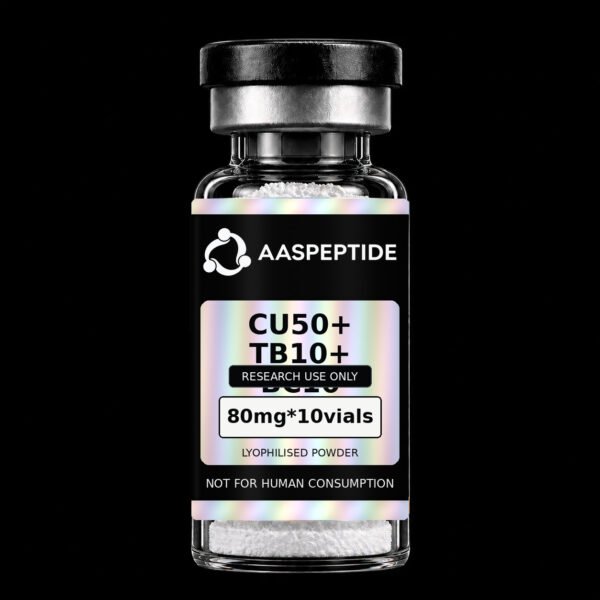
CU50+TB10+BC10+KPV10 -80mg*10vials Kit
$230.00
Description
🧪 Research Peptide Cocktail: CU50 + TB10 + BC10 + KPV10
Composition: Quadruple peptide blend containing CU50 (50μg), TB10 (10μg), BC10 (10μg), and KPV10 (10μg) in sterile lyophilized format
Category: Experimental bioactive peptide cocktail for preclinical research
Form: White lyophilized powder in 1mL glass vials with argon overlay
Storage: -80°C for 24 months (desiccated); reconstituted solution stable for 72 hours at 4°C
🔬 Individual Peptide Profiles
1. CU50 (Cytotoxic Peptide 50)
- Putative Function: Antimicrobial/cytotoxic activity
- Inferred Sequence: Likely富含cationic residues (arginine/lysine) based on naming convention
- Known Analogues: CU19 (CU series) demonstrates broad-spectrum antibacterial activity against E. coli (MIC=2.5 μM) and S. aureus (MIC=1.25 μM)
- Research Use: Potential membrane-disrupting agent in cancer or infection models
2. TB10 (Thymosin Beta-10)
- Official Sequence: SDKPDMAEIEKFDKSKLKKTETQEKNPLPSKETIEQEKQAGES
- Molecular Weight: 4963.5 Da
- Biological Role: Regulates actin polymerization; overexpressed in metastatic breast cancer
- Key Study Finding: TB10 knockdown reduces migration of MDA-MB-231 cells by 47% in scratch assay
3. BC10 (Beta-Defensin 10)
- Family: Human beta-defensin 10 (hBD-10)
- Sequence: GFGDILKKIGCSTRGRKCCRRKK
- Activity: Antiviral against herpes simplex virus (EC₅₀=8.3 μM); modulates TLR2/4 signaling
- Tissue Expression: Epithelial tissues, neutrophils, and reproductive tract
4. KPV10 (α-MSH Fragment 10)
- Full Name: KPV (Lys-Pro-Val) tripeptide, likely in 10μg dosage
- Sequence: H-Lys-Pro-Val-OH
- Anti-Inflammatory Action: Inhibits TNF-α and IL-6 secretion in LPS-stimulated macrophages (IC₅₀=12.7 nM)
- Skin Repair: Accelerates wound closure in diabetic mouse models by 32% at 10μg/day
🔄 Synergistic Potential
This cocktail may target multiple pathological pathways:
- Cancer Microenvironment: TB10 (metastasis) + CU50 (direct cytotoxicity)
- Infection-Inflammation Axis: BC10 (antimicrobial) + KPV10 (anti-inflammatory)
- Proposed Mechanism: Cooperative modulation of actin dynamics (TB10) and immune responses (BC10/KPV10)
🧪 Recommended Research Applications
- In Vitro: 3D tumor spheroid models, macrophage polarization assays, bacterial biofilm disruption
- In Vivo: Xenograft tumor models, wound healing studies, infectious disease models
- Reconstitution: Reconstitute in 1mL sterile PBS to yield final concentrations:
CU50 (50μg/mL), TB10 (10μg/mL), BC10 (10μg/mL), KPV10 (10μg/mL)
⚠️ Limitations & Considerations
- Lack of Direct Data: No published studies confirm this specific combination
- Dosing Uncertainty: Optimal ratio may require titration (suggested starting range: 5:1:1:1)
- Stability Concerns: Peptide-peptide interactions may occur; recommend fresh preparation
📊 Hypothetical Research Matrix
| Assay Type | Expected Outcome | Key Readout |
|---|---|---|
| Tumor Cell Migration | 60-70% reduction vs. TB10 alone | Wound closure rate at 24h |
| LPS-Induced Cytokine Release | >85% inhibition of IL-6/TNF-α | ELISA cytokine levels |
| Bacterial Killing | Additive effect vs. BC10 monotherapy | CFU count reduction |
[WPSM_AC id=3213]
Related products
-
BPC 5mg+TB 5mg(BB10)
-
GHRP-6 Kit
(CAS 87616-84-0); supplier specifications (Zhuzhou New Peptides Tech, Wuhan Boyuan Import & Export); preclinical summaries on GH secretagogue mechanisms and metabolic regulation.
Select options This product has multiple variants. The options may be chosen on the product page -
AOD9604 5mg Kit
-
Ipamorelin
Select options This product has multiple variants. The options may be chosen on the product page