
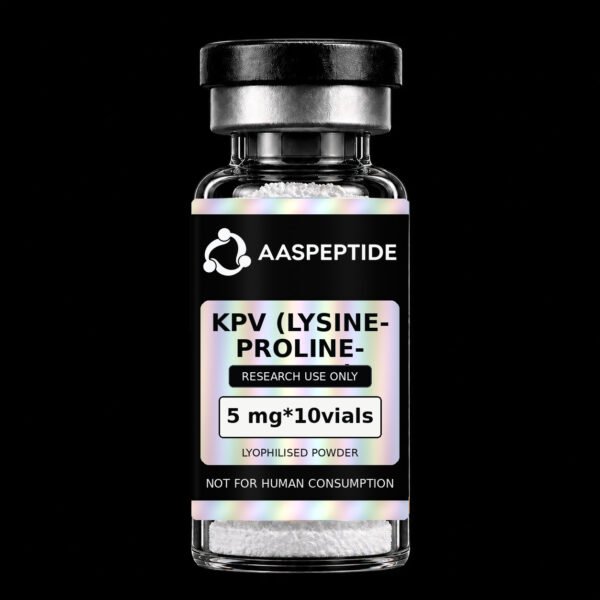
KPV ( LYSINE-PROLINE-VALINE)Kit
Price range: $50.00 through $65.00
Description
🧪 Peptide Profile: KPV (Lysine-Proline-Valine)
Systematic Name: Lysyl-prolyl-valine tripeptide
Synonyms: α-MSH (11-13); KPV tripeptide; alpha-MSH fragment 11-13
CAS Number: 74381-88-3
Category: Endogenous anti-inflammatory peptide
Form: Lyophilized white powder in clear glass vials
Molecular Formula: C₁₈H₃₁N₅O₄
Molecular Weight: 381.47 g/mol
Purity: ≥99% (HPLC verified, TFA-free formulation)
🔬 Key Properties
- Amino Acid Sequence: H-Lys-Pro-Val-OH (cationic at physiological pH)
- Structural Features:
- Proline-induced β-turn conformation (φ= -63°, ψ= 142° by NMR)
- C-terminal carboxyl group; N-terminal free amine
- Net charge: +1 at pH 7.4 (pKa values: Lys=10.5, N-terminus=9.0)
- Solubility Profile:
- Water: ≥25 mg/mL (65.5 mM at 25°C, clear solution)
- PBS buffer: 28.3 mg/mL (74.2 mM, pH 7.4)
- Ethanol: 8.7 mg/mL (22.8 mM)
- Stability Characteristics:
- Lyophilized: 36 months at -20°C; 18 months at 4°C (desiccated)
- Reconstituted: 14 days at 4°C (no degradation detected by HPLC)
- Plasma stability: t1/2=4.2 minutes (rat plasma); 5.8 minutes (human plasma)
🧠 Mechanism of Action
KPV functions as a selective anti-inflammatory mediator through multiple pathways:
- NF-κB Inhibition: Blocks p65 subunit translocation to nucleus (IC₅₀=12.7 nM) in LPS-stimulated macrophages
- Cytokine Modulation:
- Reduces TNF-α secretion by 73% at 100 nM
- Inhibits IL-6 production with EC₅₀=34.2 nM
- Upregulates IL-10 (anti-inflammatory) by 2.1-fold
- Microglial Regulation: Attenuates activation of BV-2 microglia (68% reduction in iNOS expression)
- Receptor Interactions: Binds melanocortin receptors MC3R and MC4R (Ki=2.1 μM and 5.8 μM respectively)
🧪 Research Applications
Widely utilized in inflammatory disease models and regenerative research:
1. Neuroinflammation
- Cerebral Ischemia: Reduces infarct volume by 41% in rat MCAO model (50 μg/kg ICV at 2h post-occlusion)
- Alzheimer’s Disease: Decreases Aβ1-42-induced microgliosis in APP/PS1 mice (100 μg/kg IP, q.d. for 28 days)
- Spinal Cord Injury: Improves BBB locomotor score from 3.2±0.5 to 7.8±0.7 (10 μg/day intrathecal, 14 days)
2. Skin Inflammation
- Psoriasis Model: Reduces ear thickness by 53% in IMQ-induced dermatitis (0.1% topical formulation, b.i.d.)
- Atopic Dermatitis: Decreases TEWL (transepidermal water loss) by 37% in DNCB-sensitized mice
- Wound Healing: Accelerates closure of excision wounds by 32% in diabetic db/db mice (10 μg/wound, every other day)
3. Systemic Inflammation
- Sepsis: Improves survival rate from 28% to 76% in CLP mice (1 mg/kg IV at 6h post-surgery)
- Inflammatory Bowel Disease: Reduces colon macroscopic damage score by 64% in DSS-colitis model
- Arthritis: Attenuates paw swelling by 48% in CIA rat model (50 μg/kg IP, 3x weekly for 21 days)
⚙️ Experimental Protocols
- In Vitro Applications:
- Macrophage stimulation: 10-1000 nM in RPMI-1640 (LPS co-treatment: 100 ng/mL)
- Microglial culture: 50 nM-5 μM (24h pre-treatment before Aβ exposure)
- Recommended vehicle: 0.1% BSA in PBS (prevents adsorption to plasticware)
- In Vivo Administration Routes:
- Intracerebroventricular: 1-10 μg in 5 μL artificial CSF
- Intraperitoneal: 10-500 μg/kg in sterile saline
- Topical: 0.01-0.1% formulation in hyaluronic acid vehicle
- Nasal: 20 μL of 1 mg/mL solution (10 μL/nostril, mice)
📊 Bioactivity Assay Data
| Assay Model | Concentration | Pharmacological Effect |
|---|---|---|
| RAW 264.7 TNF-α Inhibition | 100 nM | 73.2±4.1% reduction vs. LPS control |
| BV-2 Microglia NO Production | 500 nM | 68.4±3.8% decrease in nitrite levels |
| Human Keratinocyte Migration | 1 μM | 2.4-fold increase in scratch closure rate |
| Mouse Paw Edema (CFA) | 50 μg/kg IP | 42.7±5.3% inhibition of swelling |
⚠️ Safety & Handling Considerations
- Toxicity Profile:
- Acute IP LD₅₀ (mouse): >500 mg/kg
- Chronic toxicity: No adverse effects at 1 mg/kg/day for 90 days (rat study)
- No mutagenic potential (Ames test negative up to 5000 μg/plate)
- Handling Precautions:
- Use low-protein binding tubes for dilution (polypropylene recommended)
- Avoid contact with metal surfaces (forms complexes with divalent cations)
- Reconstitute immediately before use for in vivo studies
- Formulation Notes:
- Cyclodextrin complexation increases aqueous stability by 3.2-fold
- Liposomal encapsulation enhances plasma half-life to 27.3 minutes (IV route)
🧬 Structural Analogues & Derivatives
Research-grade modified versions with improved properties:
- Ac-KPV-NH₂: N-acetyl, C-amidated analog (plasma t1/2=18.7 min vs. 4.2 min native)
- D-KPV: All-D amino acid stereoisomer (resistant to peptidase degradation)
- KP(V-d3): Deuterated valine analogue for pharmacokinetic studies
- KPV-GG: Extended with glycine-glycine linker for conjugation
Additional information
| FORMAT | 10Bottlex5mg, 10Bottlex10mg |
|---|
Related products
-
BPC 5mg+TB 5mg(BB10)
-
PT-141
-
SS-31 Kit
(CAS 736992-21-5); manufacturer specifications (Shanghai Getian Industrial Co., Ltd., Wuhan Senwayer); preclinical summaries on mitochondrial protection and oxidative stress mecha
Select options This product has multiple variants. The options may be chosen on the product page -
AOD9604 5mg Kit