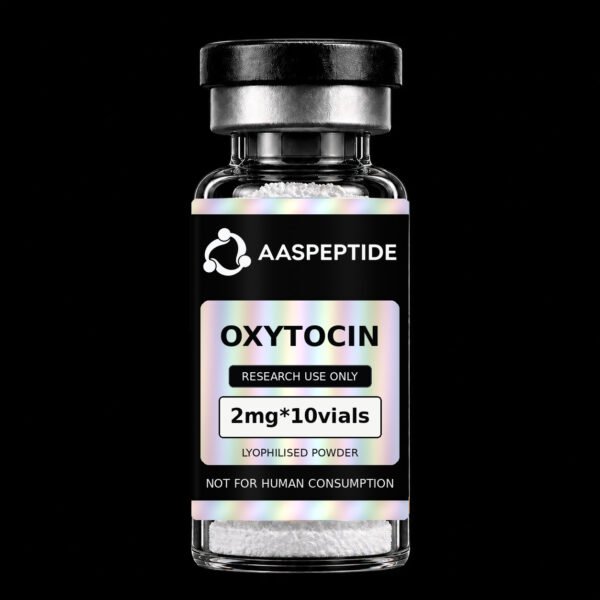
Oxytocin Acetate 2mg*10vials Kit

$35.00

Description

🧪 Product Profile: Oxytocin Acetate (2mg)

Product Name: Oxytocin Acetate
CAS Number: 50-56-6; 6233-83-6 (acetate salt)
Category: Neurohypophyseal peptide hormone; research reagent
Form: Sterile lyophilized powder in 2mg glass vials
Molecular Formula: C₄₃H₆₆N₁₂O₁₂S₂·C₂H₄O₂ (acetate complex)
Molecular Weight: 1007.19 g/mol (free base); 1083.27 g/mol (acetate salt)
Purity: ≥98% (HPLC, TFA-free formulation)

🔬 Key Properties

  • Amino Acid Sequence: CYIQNCPLG-NH₂ (disulfide bridge between Cys¹ and Cys⁶)
  • Physical Appearance: White to off-white amorphous powder
  • Solubility:
    • Water: ≥25 mg/mL (clear solution at pH 7.4)
    • PBS buffer: 23.42 mM (25 mg/mL with gentle sonication)
    • DMSO: 125 mg/mL (117.12 mM, stable for 6 months at -80°C)
  • Storage Stability:
    • Lyophilized: 24 months at -80°C; 12 months at -20°C (desiccated)
    • Reconstituted: 48 hours at 2-8°C; avoid repeated freeze-thaw cycles

🧠 Biological Functions

As a pleiotropic neuropeptide, oxytocin acetate modulates:

  • Social Behavior: Enhances pair bonding, trust, and maternal-infant attachment in rodent models (0.1 mg/kg SC increases social interaction time to 71.6±4.3s vs. 56.9±4.1s in controls)
  • Reproductive Physiology: Stimulates uterine smooth muscle contraction (EC₅₀=1.9 µM) and mammary gland lactation
  • Stress Regulation: Reduces HPA axis activity by suppressing cortisol release
  • Neural Plasticity: Facilitates synaptic pruning in the amygdala, regulating fear responses

🔬 Research Applications (2mg Vial Use Cases)

The 2mg规格 is ideal for:

  • Behavioral Studies: 5-10 intracerebroventricular (ICV) injections in mice (20-40 µg/dose)
  • Cell Culture: Treating 20-40 wells (96-well plate) at 1-10 µM concentrations
  • Biochemical Assays: Receptor binding studies (Ki=1.2 nM at human oxytocin receptors)
  • Pharmacokinetic Profiling: Single-dose PK studies in rats (0.3 mg/kg SC produces peak plasma levels at 15-30 min)

⚙️ Reconstitution Protocol

For 2mg vial:

  1. Add 800 µL sterile PBS (pH7.4) to achieve 2.5 mg/mL stock solution
  2. Sonicate for 30 seconds to ensure complete dissolution
  3. Dilute to working concentration (e.g., 100 µM = 40 µL stock + 960 µL buffer)
  4. Aliquot into 50-100 µL portions and store at -80°C

📦 Packaging Specifications

  • Primary Container: 10mm borosilicate glass vial with butyl rubber stopper
  • Sealing: Aluminum crimp seal with flip-off cap
  • Label Information: Lot number, expiration date, storage conditions, and “For Research Use Only” statement
  • Secondary Packaging: Individually boxed with silica gel desiccant

⚠️ Safety & Handling

  • Hazard Class: Not classified as hazardous (GHS 0) but requires standard peptide precautions
  • PPE Requirements: Nitrile gloves, lab coat, safety glasses during reconstitution
  • Disposal: Unused solution as chemical waste; vials as sharps waste
  • Regulatory Status: Research Use Only (RUO); not for human or veterinary use
  • Special Note: Acetate salt form improves stability compared to free base, with minimal impact on receptor binding affinity

📊 2mg Vial Research Applications Table

Study Type Typical Dosage Volume per Vial Animals/Assays per Vial
Rodent ICV Injection 20 µg/mouse 80 µL reconstituted 25 mice (single dose)
Rat Subcutaneous 0.1 mg/kg (200g rat) 400 µL reconstituted 5 rats (single dose)
Cell Culture 1 µM (96-well plate) 2 mL working solution 4 plates (1 well/condition)
Binding Assay 0.1-100 nM 10 mL assay buffer 100 reactions
[WPSM_AC id=3213]
WhatsApp Email